
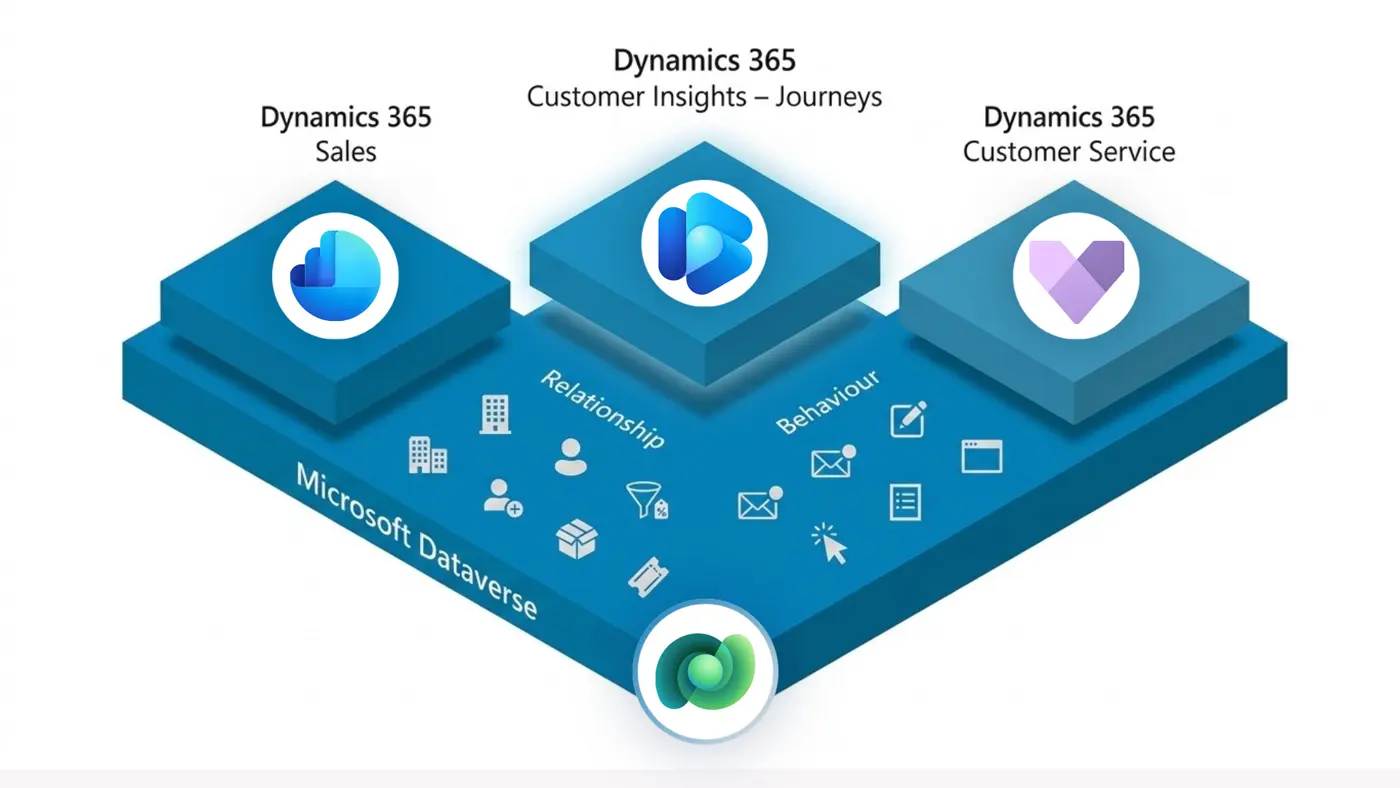
In short: When marketing automation sits apart from Dynamics 365, sales and service teams work blind to what marketing sent, and marketing risks working with stale or incomplete data. Real-time marketing in Dynamics 365 Customer Insights – Journeys stores marketing interactions in Dataverse alongside contacts, accounts and cases, so segments stay current and messages trigger the moment a customer acts.
When marketing automation runs on a platform separate from Dynamics 365, the people closest to your customers often work without the full picture.
An account manager opens a contact record but has no idea what marketing emailed them last week, or whether they clicked it. A service agent handles a case without knowing that the same person has just viewed a product page.
Meanwhile, marketing risks building audiences with incomplete data or using information that’s a day or two behind, and reports on activity using metrics that mean little to the rest of the business.
Real-time marketing in Dynamics 365 Customer Insights – Journeys sits on the same platform as the rest of your CRM. Marketing interactions are stored in Microsoft Dataverse alongside your contacts, accounts, cases and orders. That single change reshapes what marketing can do and what everyone else can see.
Unified data is the foundation
Plenty of organisations run a standalone marketing platform connected to Dynamics 365 and see good results. But a CRM connector can only move so much data, so often. Missing intent triggers or gaps of just a few hours can be the difference between a message that feels relevant and one that lands awkwardly.
When marketing interactions live in Dataverse, the email someone opened this morning is immediately shown on their contact record. Audience lists are built from the same fields sales and service rely on, without a spreadsheet bridging the gap.
To target an audience segment, even complex queries with rules spanning contacts, accounts and other related tables become something marketing teams can quickly create without IT support.
Once built, segments refresh, so the audience at the point of send reflects what’s true now rather than what was true when a list was created.
Shared data changes what a message can carry. Conditional rules can adjust blocks of content based on what you know, like a contact’s sector, their order history, the value of their account, or the campaigns they’ve engaged with. An email or SMS template may be sent at the same point in a customer journey, but data personalises the message each person receives, reflecting your knowledge of their relationship with you.
Messages arrive when moments are live
An email sent within minutes of someone acting will spark more conversations than the same email sent to a list refreshed last week, because it arrives while the intent is still there.
What makes that possible is the range of events that can trigger a message. A customer action, like a form submitted, a link clicked or a pricing page viewed, can start a journey while interest is fresh.
A change in a Dynamics record can do the same, whether that’s an opportunity reaching a new stage, an account value crossing a threshold or a renewal date drawing near. And because you can define your own events, almost anything your business considers significant can become a starting point, from a signed contract to a registered product.
The result is messages that respond to what is happening now, rather than a schedule set weeks ago.
Why sales, service and operational teams gain too
Customer Insights – Journeys is a marketing application, but the data it acts on and the messages it sends needn’t be exclusively marketing.
Because every team’s data sits on one platform, a journey can respond to a service team’s case resolution, an operations warranty expiry, or a renewal date an account manager is tracking. The trigger event and the data come from those teams. The journey that acts on them is built once, in one place, and what it sends might be a transactional update or a service follow-up rather than a campaign.
Lead handover improves for the same reason. Disagreements between sales and marketing over what a qualified lead looks like usually come from each team having different definitions. With scoring rules built on shared data – including demographic, organisational and behavioural – the criteria can be jointly agreed and consistently applied. Whether these are scoring models for an ideal customer profile, purchase intent, or other scenarios, they give both teams a clear framework.
Visibility on contact records that everyone can use
Once marketing interactions appear on the contact record, what teams can see changes. The timeline people already use to monitor activity also shows the emails an individual has received, what they opened, what they clicked, and any forms they submitted.
The communication tab shows their opt-in status, so everyone can see whether further messages will be sent. Anyone preparing for a call no longer needs to ask marketing whether a recent email went out or guess how it was received.
Value runs the other way, too. By tying page views on submitted forms to the leads they generate, marketing can report which content prompted the action and trace that lead through to the opportunity and resulting order. That shifts leadership presentations from open and click rates to which campaigns contribute to the pipeline.
A reason to take another look at marketing automation
Replacing a marketing platform is rarely at the top of anyone’s to-do list, and the case for change tends to arrive in stages. A customer milestone date that’s passed before anyone noticed. A sales team asking why they can’t see what was sent. Board questions about marketing’s contribution, which the current numbers don’t answer.
If any of those feel familiar, moving marketing onto the same platform as your contacts, accounts and pipeline data may help your teams answer those questions in the moment.
ServerSys works with organisations evaluating and using Customer Insights. Please get in touch if you want to discuss how it could work for your business.
What could your teams do differently if marketing data sat alongside everything else you know about a customer in Dynamics 365?