
Why system modernisation costs less
Asking an IT provider to modernise a legacy system has usually meant one answer: a replacement project, a six-figure cost and months of operational upheaval. Many providers still lead with that approach.
AI-assisted engineering has lowered the cost of understanding and improving an unfamiliar system. But the developers who know your system best rarely get to this work. Modernisation is not their brief, and many are cautious about using AI with a system they are responsible for.
Our tooling reads your code, databases and configuration together, which was the slow part of taking on a system. With that done, our team handles day-to-day issues, closes security weaknesses and improves your system where it stands. That cuts the technical debt, which made every fix expensive.
What changes for you
Reduced technical debt
Security gaps closed and faults cleared.
Support from day one
A named team and defined escalation route.
A system worth keeping
Improvement for far less than replacement.
Our work, phase by phase
Understand
We analyse the code, data and configuration, then document how your system behaves, fails and connects to daily operations.
Stabilise
Closing security weaknesses such as disabled permission checks and readable credentials, and dealing with recurring problems that cause the most issues.
Improve
We prioritise system changes by business value. New reports, quicker processes, connections to your other applications, and other requests that have been on your backlog list for years.
Retire
If a capability is better served elsewhere, we’ll prove the new version in live use before switching off the old one. Often this phase isn’t needed because an improved system now does what the business needs.
How our approach compares
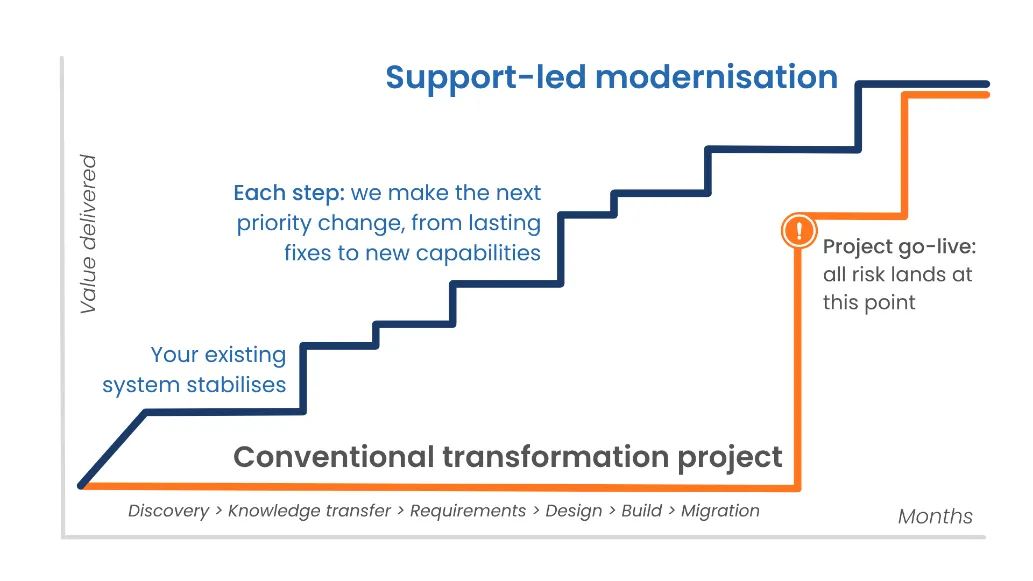
Conventional transformation projects hold back every benefit of a new system until go-live and concentrates all the risk at that point.
ServerSys support-led modernisation addresses the exposed parts of your system first, then works through what’s next to deliver phased improvements.
Example systems we take on and modernise
These are just a few examples – contact us to tell us about your system.
Bespoke Access databases
Often built for job costing, stock control, audit records or asset registers, with no remote access or system integration.
VB6 & WinForms apps
Built around environments that are hard to recreate, so every fix, upgrade or change risks disturbing something critical.
Legacy web applications
Built years ago by a former developer or agency, with source code that nobody has a full grasp of, so even simple requests incurs high costs.
Spreadsheet-run processes
Macros and dozens of tabs run a live process, with no version control and no record of who changed what. A web application fixes both.
Discontinued CRM systems
Vendor development has stopped, leaving years of customer data to migrate before anything can replace it.
Lotus Notes
Often hold critical workflows in legal, insurance and manufacturing, on platforms few suppliers now support.
How we safely use AI
Our experienced consultants and developers lead this work. AI shortens the analysis. Nothing our tooling produces reaches your production environment until a senior engineer has read it, tested it and put their name to it.
AI reads first
Your system analysed in one pass
Our engineers review
Risks and improvement priorities agreed with you
Safeguards before go-live
Automated checks, peer review and named approval
What it costs
The quickest way to assess our approach is to let us look at your system.
Our discovery work is completed within 1-2 weeks and costs £3,500 to £5,500, depending on complexity. We agree on the price before we start and complete this work on a fixed-price basis.
Discovery
System Understanding
We uncover how it supports your day-to-day operations, including the parts that aren't documented.
Risks Identified
We identify technical debt, security weaknesses and dependencies that could become expensive problems.
Route forward
We show what can be improved, what may need replacing and what that will cost.
You get documented findings: how your system works underneath, the risk it carries, and a costed proposal.
If the answer is a support arrangement and a list of recommended improvements, our quote will cost a fraction of a replacement project.
Why ServerSys
Modernising systems since 1998
A boutique UK consultancy that has helped businesses and non-profits with 25-500 users change how they work through technology.
96% client retention
Measured across the last 10 years. Many clients have been with us for 15+ years.
UK team, no subcontractors
Experienced consultants and developers work on every project. We already act as an extension of in-house development teams for several clients.
Senior technical oversight
Our consultants design the architecture, judge what is safe to do, and validate each change before it goes live.
Engineer-led delivery
Our engineers work within approved tooling and agreed rules. Every change carries a named engineer’s approval.
Covered by PI insurance
We hold professional indemnity insurance for our system development work.
Frequently Asked Questions
Book a 20-minute call
Your business runs on a decades-old system that’s restricting growth, but changing it looks expensive. We’ll turn it back into an asset and keep it moving.
Tell us about your system and the challenges you face. Book a call with one of our senior consultants who will say whether we can take it on and give you an early view of what modernising it would involve.